Commands for Parents (Part 2) | Ephesians Study

Ephesians 6:4, 

And, ye fathers, provoke not your children to wrath: but bring them up in the nurture and admonition of the Lord.


Bring them up in the nurture and admonition of the Lord
What is the Father’s responsibility in raising children? In our society, it is often given to the mothers to see after the spiritual rearing of their children. But what do we see in God’s Word?
The Mother and Child
” If a man have a stubborn and rebellious son, which will not obey the voice of his father, or the voice of his mother, and that, when they have chastened him, will not hearken unto them:” (Deuteronomy 21:18)
“My son, hear the instruction of thy father, and forsake not the law of thy mother:” (Proverbs 1:8)
“My son, keep thy father’s commandment, and forsake not the law of thy mother:” (Proverbs 6:20)
“The rod and reproof give wisdom: but a child left to himself bringeth his mother to shame.” (Proverbs 29:15)
“A wise son maketh a glad father: but a foolish son is the heaviness of his mother.” (Proverbs 10:1)
Older women are to teach younger women (Titus 2:3-5)
A mother can instruct her children and give laws for them. We also notice that a wayward child brings shame and heaviness to his mother.

The powerful influence of mothers:
“Ahaziah the son of Ahab began to reign over Israel in Samaria the seventeenth year of Jehoshaphat king of Judah, and reigned two years over Israel. And he did evil in the sight of the Lord, and walked in the way of his father, and in the way of his mother, and in the way of Jeroboam the son of Nebat, who made Israel to sin:” (1 Kings 22:51-52)
“When I call to remembrance the unfeigned faith that is in thee, which dwelt first in thy grandmother Lois, and thy mother Eunice; and I am persuaded that in thee also.” (2 Timothy 1:5)
A mother has a strong influence over her children. This influence can either be good or bad; the children likely will follow in her footsteps.
The Father and the Child
-The father’s responsibility to his daughter.
“But if the priest’s daughter be a widow, or divorced, and have no child, and is returned unto her father’s house, as in her youth, she shall eat of her father’s meat: but there shall no stranger eat thereof.” (Leviticus 22:13)
-The father’s responsibility to remind his children of God’s marvelous works.
“That this may be a sign among you, that when your children ask their fathers in time to come, saying, What mean ye by these stones? Then ye shall answer them, That the waters of Jordan were cut off before the ark of the covenant of the Lord; when it passed over Jordan, the waters of Jordan were cut off: and these stones shall be for a memorial unto the children of Israel for ever.” (Joshua 4:6-7)
“And he spake unto the children of Israel, saying, When your children shall ask their fathers in time to come, saying, What mean these stones? Then ye shall let your children know, saying, Israel came over this Jordan on dry land. For the Lord your God dried up the waters of Jordan from before you, until ye were passed over, as the Lord your God did to the Red sea, which he dried up from before us, until we were gone over: That all the people of the earth might know the hand of the Lord, that it is mighty: that ye might fear the Lord your God for ever.” (Joshua 4:21-24)
“The living, the living, he shall praise thee, as I do this day: the father to the children shall make known thy truth.” (Isaiah 38:19)
-The father’s influence
“So these nations feared the Lord, and served their graven images, both their children, and their children’s children: as did their fathers, so do they unto this day.” (2 Kings 17:41)
“Children’s children are the crown of old men; and the glory of children are their fathers.” (Proverbs 17:6)
-Commands for the fathers
“And, ye fathers, provoke not your children to wrath: but bring them up in the nurture and admonition of the Lord.”(Ephesians 6:4)
“Fathers, provoke not your children to anger, lest they be discouraged.” (Colossians 3:21)
-Examples of a father
” Like as a father pitieth his children, so the Lord pitieth them that fear him.” (Psalm 103:13)
“As ye know how we exhorted and comforted and charged every one of you, as a father doth his children, That ye would walk worthy of God, who hath called you unto his kingdom and glory.” (1 Thessalonians 2:11-12)
-The commands for children to their fathers
“Hear, ye children, the instruction of a father, and attend to know understanding.” (Proverbs 4:1)
“The father of the righteous shall greatly rejoice: and he that begetteth a wise child shall have joy of him.” (Proverbs 23:24)
“A wise son heareth his father’s instruction: but a scorner heareth not rebuke.” (Proverbs 13:1)
“A wise son maketh a glad father: but a foolish man despiseth his mother.” (Proverbs 15:20)
“A foolish son is a grief to his father, and bitterness to her that bare him.” (Proverbs 17:22)
“A foolish son is the calamity of his father: and the contentions of a wife are a continual dropping.” (Proverbs 19:13)
“He that wasteth his father, and chaseth away his mother, is a son that causeth shame, and bringeth reproach.”(Proverbs 19:26)
“Whoso keepeth the law is a wise son: but he that is a companion of riotous men shameth his father.” (Proverbs 28:7)

Conclusion: while godly mothers who teach their children God’s Word are a blessing and mightily used in God’s kingdom, they were never intended to replace the fathers. How much we need godly fathers who will rear their children in the nurture and admonition of God!


Commands for Parents (Part 1) | Ephesians Study

Ephesians 4:1, 

And, ye fathers, provoke not your children to wrath: but bring them up in the nurture and admonition of the Lord.

Provoke to wrath –  NT:3949 parorgizo (par-org-id’-zo); from NT:3844 and NT:3710; to anger alongside, i.e. enrage:
Nurture – NT:3809  paideia (pahee-di’-ah); from NT:3811; tutorage, i.e. education or training; by implication, disciplinary correction:
Admonition – NT:3559 nouthesia (noo-thes-ee’-ah); from NT:3563 and a derivative of NT:5087; calling attention to, i.e. (by implication) mild rebuke or warning:
Again, we see another “put off/put on”: put off provocation, put on nurture and admonition.
It is possible for fathers to be guilty of provoking their children to wrath – otherwise, they would not be warned against it. Colossians 3:21 reiterates this, “Fathers, provoke not your children to anger, lest they be discouraged.” Here, lies the responsibility of the father, not of the children. Children have already been commanded to obey and honor, but fathers should never use that as a reason to do whatever they desire. Even by demanding obedience and honor, fathers can provoke their children to wrath.
Instead of provocation, fathers are given the command to raise their children with nurture (education, training, disciplinary correction) and admonition (calling attention, mild rebuke or warning). These words help us to understand the attitude behind training. Instead of forceful, angry training, fathers are to have a humble attitude. They can discipline their children and rebuke them, but it is done in a gentle spirit. The issue at hand is not the means of raising children, but the attitude of raising children.
What better example of fatherhood is there than God the Father? Hebrews 12 gives us a glimpse of God the Father: “(5) And ye have forgotten the exhortation which speaketh unto you as unto children, My son, despise not thou the chastening of the Lord, nor faint when thou art rebuked of him: (6) For whom the Lord loveth he chasteneth, and scourgeth every son whom he receiveth. (7) If ye endure chastening, God dealeth with you as with sons; for what son is he whom the father chasteneth not? (8) But if ye be without chastisement, whereof all are partakers, then are ye bastards, and not sons. (9) Furthermore we have had fathers of our flesh which corrected us, and we gave them reverence: shall we not much rather be in subjection unto the Father of spirits, and live? (10) For they verily for a few days chastened us after their own pleasure; but he for our profit, that we might be partakers of his holiness. (11) Now no chastening for the present seemeth to be joyous, but grievous: nevertheless afterward it yieldeth the peaceable fruit of righteousness unto them which are exercised thereby.” (Hebrews 12:5-11)

God does not father without chastening – but His chastening is always rooted in His love for us and His interest in our profit. God never chastens because it just “feels good” to chasten. He always has a reason for His chastisement.

Commands for Children (Part 2) | Ephesians Study

Ephesians 6:2, Honour thy father and mother; (which is the first commandment with promise;)
After a child is to obey their parents, they are to honor them. Honor means (NT:5091 timao) “to prize, i.e. fix a valuation upon; by implication, to revere:”
Doing a further study of this Greek word, we find out a little more about honor.
Children Honoring Parents
“For God commanded, saying, Honour thy father and mother: and, He that curseth father or mother, let him die the death. But ye say, Whosoever shall say to his father or his mother, It is a gift, by whatsoever thou mightest be profited by me; And honour not his father or his mother, he shall be free. Thus have ye made the commandment of God of none effect by your tradition. Ye hypocrites, well did Esaias prophesy of you, saying, This people draweth nigh unto me with their mouth, and honoureth me with their lips; but their heart is far from me.” (Matthew 15:4-8)
“For Moses said, Honour thy father and thy mother; and, Whoso curseth father or mother, let him die the death: But ye say, If a man shall say to his father or mother, It is Corban, that is to say, a gift, by whatsoever thou mightest be profited by me; he shall be free. And ye suffer him no more to do ought for his father or his mother; Making the word of God of none effect through your tradition, which ye have delivered: and many such like things do ye.” (Mark 7:10-13)
Directly linked to children honoring their parents is people dishonoring God. To say that a child should not honor his parents is clearly disagreeable to God. We cannot change the Scripture to “fit our times,” but our times to fit the Scripture.
Honour thy father and thy mother: and, Thou shalt love thy neighbour as thyself.” (Matthew 19:19)
“And Jesus said unto him, Why callest thou me good? there is none good but one, that is, God. Thou knowest the commandments, Do not commit adultery, Do not kill, Do not steal, Do not bear false witness, Defraud not, Honourthy father and mother.” (Mark 10:18-19)
There is no doubt that Jesus accepted and preached honor to parents. This is an Old Testament command reiterated in the New Testament. Seeing that God saw fit to mention it so many times in His Word, who are we to use exceptions to this command?
Honoring God
“That all men should honour the Son, even as they honour the Father. He that honoureth not the Son honoureth not the Father which hath sent him.”(John 5:23)
“Jesus answered, I have not a devil; but I honour my Father, and ye do dishonour me.” (John 8:49)
The same word used for honoring parents is used in terms of honoring God. Jesus Christ Himself was an example of One Who honored His Father.
God’s Honor
“If any man serve me, let him follow me; and where I am, there shall also my servant be: if any man serve me, him will my Father honour.” (John 12:26)
And the same word used for honoring parents and God is used . . . for God honoring us!
Honor All Men
Honour all men. Love the brotherhood. Fear God. Honour the king.” (1 Peter 2:17)
This, I feel, is the ultimate conclusion of honor: children are to honor their parents, believers are to honor God, and by that practice, believers should honor all men and those in political authority over them. In this day and age, we do not see a movement of honor. Instead, there are many rebellious and proud individuals who feel they should honor and obey no one. This is clearly unscriptural.

Commands for Children (Part 1) | Ephesians Study


Ephesians 6:1
Children, obey your parents in the Lord: for this is right.

Colossians 3:20, “Children, obey your parents in all things: for this is well pleasing unto the Lord.”
In case one doesn’t fully understand the simple command, “obey” means (NT:5219 hupakouo) “to hear under (as a subordinate), i.e. to listen attentively; by implication, to heed or conform to a command or authority:” Children are to put themselves under the God-given authority of their parents. It is right (equitable, innocent, holy). It is well pleasing (fully agreeable) to the Lord.
These verses indicate more than simple obedience to parents. We are not to obey our parents because it is right in theireyes and well pleasing unto them. It is a higher standard than that: by obeying their parents, the children are obeying God. Even at a young age, children can (and should) understand that it is not merely an act of obeying parents, but much more importantly, an act of obeying (or disobeying) God.
Ephesians 6:2, Honour thy father and mother; (which is the first commandment with promise;)
After a child is to obey their parents, they are to honor them. Honor means (NT:5091 timao) “to prize, i.e. fix a valuation upon; by implication, to revere:”
Ephesians 6:3, That it may be well with thee, and thou mayest live long on the earth.
Not only do we see that God has commanded us to obey; but He has so much as given us a promise for when we do obey. God’s commands are not without blessings – if we follow. Do we want things to be well with us? Well then, we must deny ourselves and humble ourselves to obey God’s commands. Do we want a long life? We must again deny our “rights” and humble ourselves to God’s commands. It is as simple as that. 

Conclusion

If you have never studied your Bible before, the information we have been covering the past few weeks is probably a little overwhelming. You might want to try it all or you might want to give up. Please, take things one step at a time.

Pray
Ask God how He would have you to study. It might be something completely different than what I have suggested and that is fine! Do as God leads.
Study
Some people need to study a few minutes every day, others prefer to set aside several hours once or twice a week. Again pray to see what plan God would have for you.
Apply
As you study God’s Word, He will begin to use it in your life (For the word of God is quick, and powerful, and sharper than any twoedged sword, piercing even to the dividing asunder of soul and spirit, and of the joints and marrow, and is a discerner of the thoughts and intents of the heart.”Hebrews 4:12).

To study and never apply is described in James 1:22-25, “But be ye doers of the word, and not hearers only, deceiving your own selves. For if any be a hearer of the word, and not a doer, he is like unto a man beholding his natural face in a glass: For he beholdeth himself, and goeth his way, and straightway forgetteth what manner of man he was. But whoso looketh into the perfect law of liberty, and continueth therein, he being not a forgetful hearer, but a doer of the work, this man shall be blessed in his deed.” As we begin to study God’s Word, are we entering with a humble spirit to learn and apply, or are beholding God’s truth then turning away, ignoring His Word in disobedience?

Only the Bible

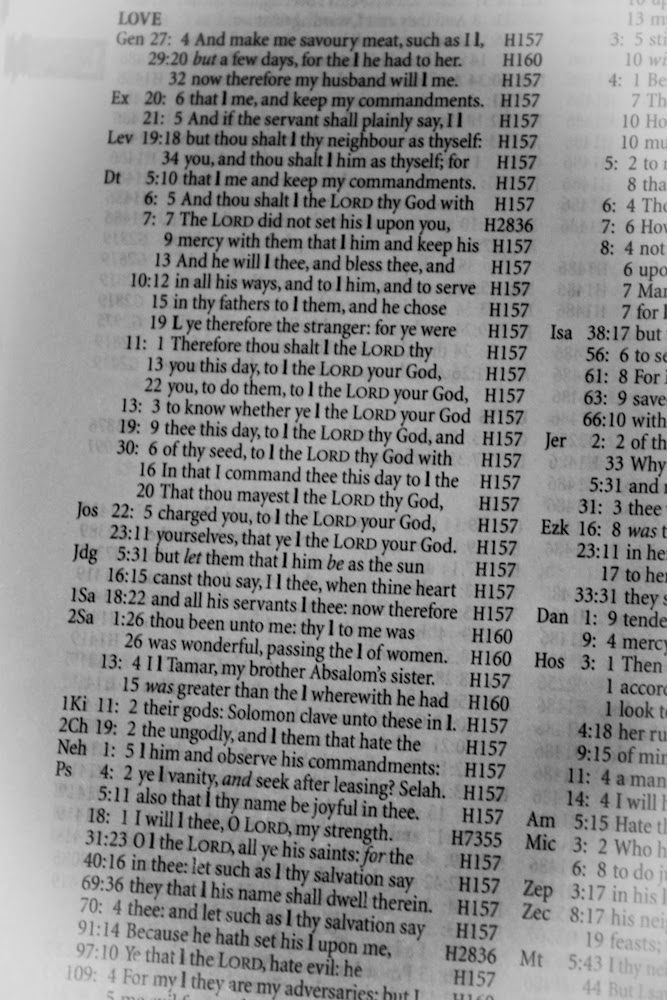
Once you know how to find the words and their root words in a concordance, you can use simply the Bible as a concordance for the Bible. For instance, from the passage above, I can search for the word “sanctification” and I come up with:

If you notice, the root word for “sanctification” is always G-38. Looking up G-38, you will see that underneath the definition is a list of all of the words used from that specific Greek word.
Besides “sanctification,” G-38 is also translated as “holiness.” Now, look up the word “holiness” and find those with the root word G-38. Here are all of the words that I found with the root G-38 (both “holiness” and “sanctification”):
“I speak after the manner of men because of the infirmity of your flesh: for as ye have yielded your members servants to uncleanness and to iniquity unto iniquity; even so now yield your members servants to righteousness unto holiness.” (Romans 6:19)
“But now being made free from sin, and become servants to God, ye have your fruit unto holiness, and the end everlasting life.” (Romans 6:22)
“But of him are ye in Christ Jesus, who of God is made unto us wisdom, and righteousness, and sanctification, and redemption:”(1 Corinthians 1:30)
“For this is the will of God, even your sanctification, that ye should abstain from fornication:” (1 Thessalonians 4:3)
“That every one of you should know how to possess his vessel in sanctification and honour;” (1 Thessalonians 4:4)
“For God hath not called us unto uncleanness, but unto holiness.”(1 Thessalonians 4:7)
“But we are bound to give thanks alway to God for you, brethren beloved of the Lord, because God hath from the beginning chosen you to salvation through sanctification of the Spirit and belief of the truth:” (2 Thessalonians 2:13)
“Notwithstanding she shall be saved in childbearing, if they continue in faith and charity and holiness with sobriety.” (1 Timothy 2:15)
“Follow peace with all men, and holiness, without which no man shall see the Lord:” (Hebrews 12:14)
“Elect according to the foreknowledge of God the Father, through sanctification of the Spirit, unto obedience and sprinkling of the blood of Jesus Christ: Grace unto you, and peace, be multiplied.” (1 Peter 1:2)
Do We Need Other Books?
Is God’s Word reallyenough for the believer, or do we need other books to help us along? While study books can be extremely helpful, I would caution any Christian in using “other books.” Persuasive authors can use Scripture out of context and if we are not careful to use the Bible as our “plumb line,” we can very easily be swayed to believe something that is not fully truth. Let us take into consideration the question at hand. Why would one think that the Bible is not enough? We can read many authors, some of which will claim that we only need the Bible, others who will claim that we need extra curriculum. Well, what does the Bible Itself say about this issue?
“For whatsoever things were written aforetime were written for our learning, that we through patience and comfort of the Scriptures might have hope.” (Romans 15:4)
All Scripture is given by inspiration of God, and is profitable for doctrine, for reproof, for correction, for instruction in righteousness: That the man of God may be perfect, throughly furnished unto all good works.” (2 Timothy 3:16-17)
“According as His divine power hath given unto us all things that pertain unto life and godliness, through the knowledge of Him that hath called us to glory and virtue: Whereby are given unto us exceeding great and precious promises: that by these ye might be partakers of the divine nature, having escaped the corruption that is in the world through lust.” (2 Peter 1:3-4)
“As ye have therefore received Christ Jesus the Lord, so walk ye in Him: Rooted and built up in Him, and stablished in the faith, as ye have been taught, abounding therein with thanksgiving. Beware lest any man spoil you through philosophy and vain deceit, after the tradition of men, after the rudiments of the world, and not after Christ.” (Colossians 2:6-8) (emphasis added)
If still in doubt after reading these passages, I would recommend you to read Psalm 119 and see what God thinks about His Word. Just as God opened the understanding of His disciples to know what His Word says (“Then opened He their understanding, that they might understand the scriptures,” Luke 24:45), God will open our understanding.
As this series concludes, may we apply ourselves to diligently study God’s Word in 2014 so that
Jesus will not have to say to us as to the Pharisees, “Did ye never read in the scriptures. . .” (Matthew 21:42) or as to the Sadducees, “Ye do err, not knowing the scriptures, nor the power of God.” (Matthew 22:29)

Studying a Passage

To gain understanding of an individual passage, it is beneficial to have both the Strong’s concordance and Webster’s 1828 dictionary on hand.
Choose a Passage
Sometimes, the Lord will lead you to study through a book. Other times, maybe it is just a memory verse or another verse that God has brought to your attention.
Study Key Words
Find the key (strong) words throughout the passage (these could be many or a few). Then, look up the definitions of these words both in Strong’s Hebrew/Greek dictionary and Webster’s 1828 dictionary.
For example, I will use a study that I recently did.
1 Thessalonians 4:3-6
3 For this is the will of God, even your sanctification, that ye should abstain from fornication:
4 That every one of you should know how to possess his vessel in sanctification and honour;
5 Not in the lust of concupiscence, even as the Gentiles which know not God:
6 That no man go beyond and defraud his brother in any matter: because that the Lord is the avenger of all such, as we also have forewarned you and testified.
Sanctification
Greek – (38) hagiasmos (hag-ee-as-mos’); from NT:37; properly, purification, i.e. (the state) purity; concretely (by Hebraism) a purifier:
Webster’s – 1. The act of making holy. In an evangelical sense, the act of God’s grace by which the affections of men are purified or alienated from sin and the world, and exalted to a supreme love to God. 2. The act of consecrating or of setting apart for a sacred purpose; consecration.
Should abstain
Greek – (567) apechomai (ap-ekh’-om-ahee); middle voice (reflexively) of NT:568; to hold oneself off, i.e. refrain:
Webster’s – In a general sense, to forbear, or refrain from, voluntarily; but used chiefly to denote a restraint upon the passions or appetites; to refrain from indulgence.
Fornication
Greek – (4202) porneia (por-ni’-ah); from NT:4203; harlotry (including adultery and incest); figuratively, idolatry:
Webster’s (fornicate) – To commit lewdness, as an unmarried man or woman, or as a married man with an unmarried woman.
Honor
Greek – (5092) time (tee-may’); from NT:5099; a value, i.e. money paid, or (concretely and collectively) valuables; by analogy, esteem (especially of the highest degree), or the dignity itself:
Webster’s – 1. The esteem due or paid to worth; high estimation. 2. A testimony of esteem; any expression of respect or of high estimation by words or actions; as the honors of war; military honors; funeral honors; civil honors. 4. Reverence; veneration; or any act by which reverence and submission are expressed,as worship paid to the Supreme Being. 5. Reputation; good name; as, his honor is unsullied.
Lust
Greek – (3806) pathos (path’-os); from the alternate of NT:3958; properly, suffering (“pathos”), i.e. (subjectively) a passion (especially concupiscence):
Webster’s – 1. Longing desire; eagerness to possess or enjoy; as the lust of gain. 2. Concupiscence; carnal appetite; unlawful desire of carnal pleasure. Rom 1. 2 Pet 2. 3. Evil propensity; depraved affections and desires. James 1. Psa 81. 1. To desire eagerly; to long; with after. 2. To have carnal desire; to desire eagerly the gratification of carnal appetite. 3. To have irregular or inordinate desires. 4. To list; to like.
Concupiscence
Greek – (1939) epithumia (ep-ee-thoo-mee’-ah); from NT:1937; a longing (especially for what is forbidden):
Webster’s –  Lust; unlawful or irregular desire of sexual pleasure. In a more general sense, the coveting of carnal things, or an irregular appetite for worldly good; inclination for unlawful enjoyments.
Defraud
Greek – (4122) pleonekteo (pleh-on-cek-teh’-o); from NT:4123; to be covetous, i.e. (by implication) to over-reach:
Webster’s – 1. To deprive of right, either by obtaining something by deception or artifice, or by taking something wrongfully without the knowledge or consent of the owner; to cheat; to cozen; followed by of before the thing taken; as, to defraud; a man of his right. 2. To withhold wrongfully from another what is due to him. Defraud not the hireling of his wages. 3. To prevent one wrongfully from obtaining what he may justly claim. 4. To defeat or frustrate wrongfully.
By looking into the definitions of the word, it helps me to understand the subject this passage is speaking about.
Make it Personal
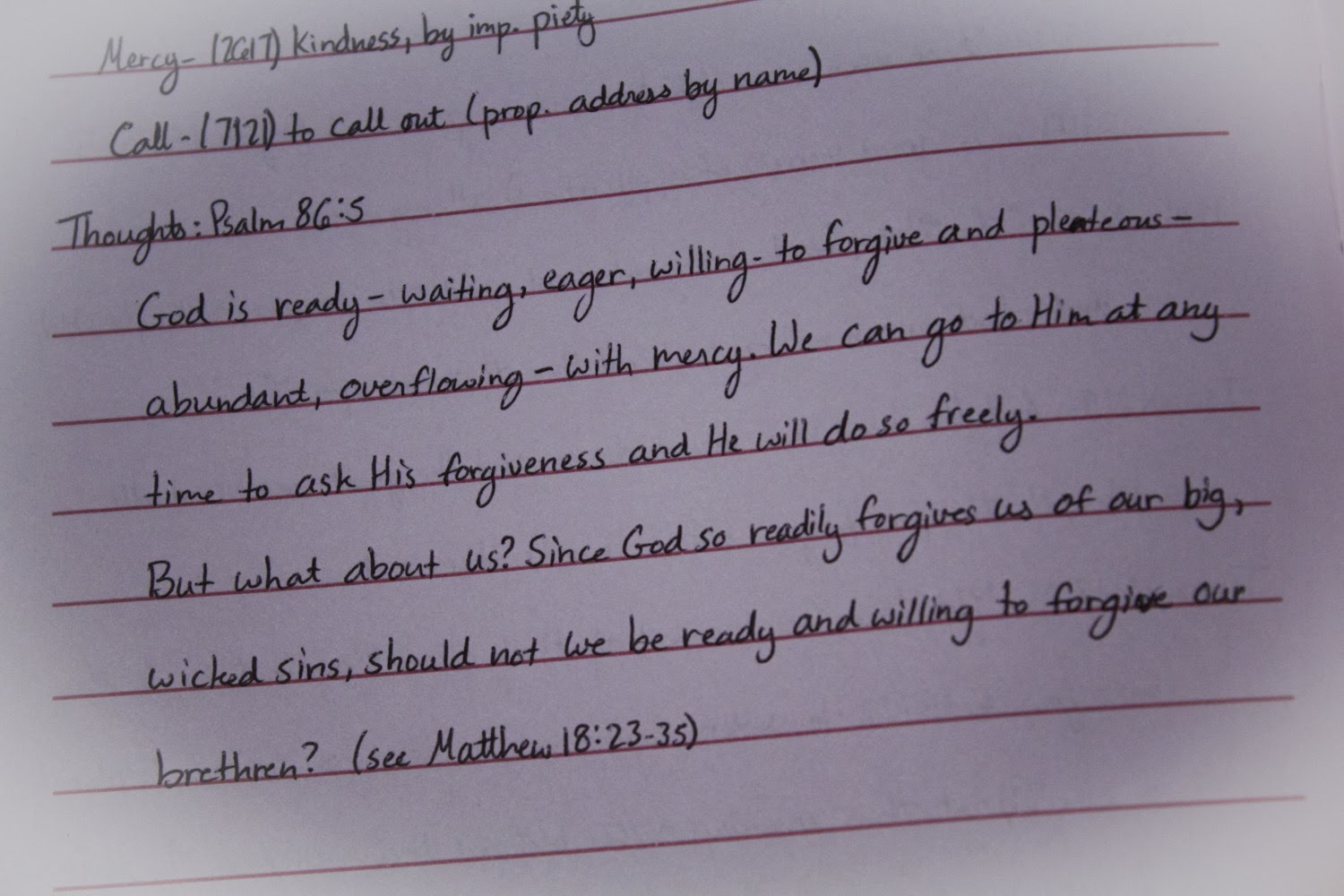
Once you study the passage, you can use the definitions to make it applicable and personal. From the definitions above, my mom wrote:
     “For this is the will of God, even purifying you and making you holy, that ye should refrain from indulging in idolatry (specifically in the physical sense), that everyone of you should know how to possess his vessel in purity and dignity . . .”
To make it personal, she wrote:

     “For this is the will of God, even purifying me and making me holy, that I should abstain from indulging in idolatry . . .”

Considering the Greek and Hebrew Words

 As you look at the Strong’s concordance, you will notice little numbers to the side of the verses. These numbers indicate the original Hebrew/Aramaic (for Old Testament) or Greek (for New Testament) words. By looking up the original word, it can shed light on the subject.

Let us take  the word “love” in the New Testament. The passage in John 21 shows a remarkable difference. I have copied the passage and inserted the Greek numbers for all forms of “love.”
John 21:15-17
15 So when they had dined, Jesus saith to Simon Peter, Simon, son of Jonas, lovest (G-25) thou me more than these? He saith unto him, Yea, Lord; thou knowest that I love (G-5368) thee. He saith unto him, Feed my lambs.
16 He saith to him again the second time, Simon, son of Jonas, lovest (G-25) thou me? He saith unto him, Yea, Lord; thou knowest that I love (G-5368) thee. He saith unto him, Feed my sheep.
17 He saith unto him the third time, Simon, son of Jonas, lovest (G-5368) thou me? Peter was grieved because he said unto him the third time, Lovest (G-5368)thou me? And he said unto him, Lord, thou knowest all things; thou knowest that I love (G-5368) thee. Jesus saith unto him, Feed my sheep.
In the back of the Strong’s concordance is a Hebrew dictionary and Greek dictionary. Be sure to flip to the correct one! For the above passage, we will find the Greek numbers 25 and 5368.
Here is what we discover:
25 agapao (ag-ap-ah’-o); perhaps from agan (much) [or compare OT:5689]; to love (in a social or moral sense):
5368 phileo (fil-eh’-o); from NT:5384; to be a friend to (fond of [an individual or an object]), i.e. have affection for (denoting personal attachment, as a matter of sentiment or feeling; while NT:25 is wider, embracing especially the judgment and the deliberate assent of the will as a matter of principle, duty and propriety: the two thus stand related very much as NT:2309 and NT:1014, or as NT:2372 and NT:3563 respectively; the former being chiefly of the heart and the latter of the head); specifically, to kiss (as a mark of tenderness):
From these definitions, we see that Jesus was asking Peter, “Do you really love Me?” and Peter was answering, “Lord, I have an affection for you.” The third time, Jesus asked, “Do you have an affection for Me?” and Peter was grieved because he could not claim to really love Christ. Reading the original definitions help shed a deeper understanding on the words.
Topical Study with Hebrew and Greek Words
With the realization of different root words, you can do a study on the individual root words. You can look up all of the verses using agape (G-25) love and then all of the verses using phileo (G-5368) love and follow the pattern of a normal topical study.

A Simple Word Search

 One of the studies that God has led me to do most often is a topical study. A topical study is when you take one word (and all of its tenses) and research every verse with that word. One can do an in depth topical study or a brief topical study.

Choose Your Word
Perhaps the Lord leads you to do a word study on “Forgiveness.” With this word in mind, write down all of the tenses and synonyms: forgive, forgiven, forgave, forgiveness, forgiveth, forgiving, pardon, and pardoned. Choose one word with which to start.
Look Up Your Word
Using a concordance (I recommend Strong’s Exhaustive Concordance), look up the verses for the first word.

Read Thoroughly
Do not skim through the verses, but read them. Remember that you are not studying to “get it checked off the list today,” but you are studying to learn.
Copy Verses
If you want only the briefest overview of the word, merely read the verses. If you want to glean more from this study, then copy the verses down. Often, as I am writing out the verses, the Lord will help me to learn something from the verse. I write this down as well. Sometimes, a verse will make me ponder a question, which I write down to study (either in this specific study or in my general list of studies).

Repeat
When you have finished going through all of the verses from your first word, look up the second word, using the same process, continuing through your list until you have covered all of the tenses.
Pulling it All Together
In studying a topic like forgiveness, it is easy to see that there are different applications of the word. Forgiveness covers God’s forgiveness towards us, our need for God’s forgiveness, how forgiveness affects our relationship with God, how we should forgive others, and specifics about what forgiveness entails. It is a good idea to take the time to categorize the verses you study. Some people categorize as they read the verses the first time. Others prefer to categorize them later.
To help you categorize verses, ask a few questions. Some general questions you could ask are:
            ~What does God’s Word say about this subject?
            ~What should we do about this subject?
            ~What should we not do about this subject?
            ~Is this speaking of God?
            ~Is this speaking of me?
            ~Is this applicable specifically to me?
Applying It
James 1:22 says, “But be ye doers of the Word, and not hearers only, deceiving your own selves.” (emphasis added) We can study God’s Word every day, but if we do not apply it to our lives, we still miss the mark. As you study, be sure to ask, “What did I learn from this study? What should I apply?” Do not just read. DO.