Giving Place to the Devil | From the Archives


Be ye angry, and sin not: let not the sun go down upon your wrath: Neither give place to the devil. Ephesians 4:26-27

To give place means ” a spot (general in space, but limited by occupancy; whereas NT:5561 is a large but participle locality), i.e. location (as a position, home, tract, etc.); figuratively, condition, opportunity; specifically, a scabbard:” (NT: 5117, topos) 
This Greek word gives the idea that the “place” is a temporary position. As believers, we cannot become possessed by the devil, because Christ and the devil cannot dwell in the same place. However, we can give place – a small part of our life – to the devil. In context, there are two ways in which to do this: 1) Sinning in our anger, and 2) Letting the sun set on our wrath.
There are other verses that deal with the believer and satan.

To whom ye forgive any thing, I forgive also: for if I forgave any thing, to whom I forgave it, for your sakes forgave I it in the person of Christ; Lest Satan should get an advantage of us: for we are not ignorant of his devices.2 Corinthians 2:10-11

If we harbor unforgiveness in our hearts, we are giving satan an opportunity to get an advantage of us.

Put on the whole armour of God, that ye may be able to stand against the wiles of the devil. Ephesians 6:11


If we do not embrace the armor of God, we cannot stand against the wiles of the devil. The armor of God is: truth, righteousness, Gospel of peace, faith, salvation, Word of God, and prayer.

Above all, taking the shield of faith, wherewith ye shall be able to quench all the fiery darts of the wicked. Ephesians 6:16

Faith quenches the devil’s darts. If we are bowing down under the weight of his attack, perhaps we should cry out to God to increase our faith.
1 Peter 5:8-9 is not the next passage in this context, but applies to Ephesians 6:16

Be sober, be vigilant; because your adversary the devil, as a roaring lion, walketh about, seeking whom he may devour: Whom resist stedfast in the faith, knowing that the same afflictions are accomplished in your brethren that are in the world.

Again, the attack of the devil is linked to our faith. We are to resist (oppose, stand against) while stedfast in the faith. If we are not steadfast in faith, we have no shield by which to resist.
And then another verse about resisting the devil:

Submit yourselves therefore to God. Resist the devil, and he will flee from you. James 4:7


We can oppose and stand against the devil. But it is interesting to see what this command is sandwiched between…
– Humility (vs. 6)
– Submission (vs. 7)
– Drawing nigh to God (vs. 8)
– Cleansing/purifying ourselves (vs. 8). 
Can we resist the devil if we are proud, independent, not trying to draw nigh to God, and living in the filthiness of our flesh?
Considering all of these verses, to keep from giving place to the devil, we must check our walk with God.
-Are we forgiving our brother?
-Have we been faithful to put on truth, righteousness, Gospel of peace, faith, salvation, Word of God, and prayer?
-Has our faith wavered from God?
-What is our heart like towards God? Have we sought to draw nigh to Him in humility, and submission while cleansing and purifying our hands and heart?
As believers, we don’t have to struggle under the oppression of the devil – God has given us a way to escape if we will but follow His Word!


Is Your All On Which Altar? | From the Archives


“Is Your All On the Altar?”  is one of my favorite hymns. It is a constant reminder to do a heart-check: What am I holding back? Yet the other day, God brought a new question to light: “Upon which altar are you laying your all?”

King Ahaz (2 Kings 16:10-16) saw the Assyrian’s pagan altar and immediately came home and patterned one identical to it. With this new altar, King Ahaz replaced the old altar that had been in the forefront of God’s house — the “old” altar being God’s altar. He never stopped sacrificing, he just replaced to whom he was sacrificing.

We might live a life of continual sacrifice, but it does not mean that we are sacrificing on God’s altar. We may have built an “altar” of the world, our dreams, or our ambitions. We may even have “good material” for our altar (family, friends, projects, gifts, talents) but instead of sacrificing this “good material” to let God use as He please, we have instead made it the altar upon which we sacrifice.

Romans 12:1 exhorts, 

I beseech you therefore, brethren, by the mercies of God, that ye present your bodies a living sacrifice, holy, acceptable unto God, which is your reasonable service.


To be a “living sacrifice” is a process of killing “self” — a willingness to change as God chooses to change us and surrendering our “right” to maintain our vision, cause, and purpose to His. It is to place our all (our whole being) upon God’s altar and leave the results up to Him.

Perhaps God is calling us to sacrifice something painful or dear to us — an ambition, a dream, a lifestyle, or even our livelihood. Elisha, when the prophet Elijah anointed him to be prophet, immediately  

…took a yoke of oxen, and slew them, and boiled their flesh with the instruments of the oxen, and gave unto the people, and they did eat. Then he arose, and went after Elijah, and ministered unto him. (1 Kings 19:21) 

Just two verses prior, Elisha had been using those very oxen to plow his field. To follow God’s call, Elisha did not hesitate to give up his livelihood — to lay his all on the altar of God. He did not stop to ask “what-ifs.” He was willing to change directions as soon as God made it known to him which direction he should change. He gave unhesitant surrender.

Is God’s altar in the forefront of our lives, or have we substituted it with another altar? The question is not “are you sacrificing?” but, “are you sacrificing to GOD?

Is your all on the altar of sacrifice laid?
Your heart, does the Spirit control?
You can never be blessed, and have peace and sweet rest,
As you yield Him your body and soul.


Elisha A. Hoffman

Will We Condemn God’s Word? | From the Archives

Wilt thou also disannul My judgment? wilt thou condemn Me, that thou mayest be righteous? (Job 40:8)

Why would anyone even try to “condemn God’s Word?” Why would they try to make it invalid? What is their purpose?
If a person can claim that God’s Word is inapplicable to them, they then have no standard by which to measure their life. If God’s Word is not to be trusted, then who can say that sodomy is a sin? Who can say that abortion is wrong? Who can say that premarital relationships are abomination to God? If we can disprove God’s Word, then we can make all of these sins appear “righteous.”
These are the big topics of sin today, but what about the little sins in our lives? Are there any areas where we are trying to disprove the Bible? Any areas that we try to “explain away” to excuse our behavior (“what this really means is . . .”)? It is easy to condemn those who blatantly disannul God’s judgments — but let us do a heart check and “see if there be any wicked way in me.”

Days of Discouragement | From the Archives

Why died I not in the womb? why did I not give up the ghost when I came out of the belly? (Job 3:11)

Those were Job’s questions as he felt the pain of everything suddenly taken from him. To his questions, God had answers, but Job could not see the answers. Job did not know that his life and trials would be used to encourage Christians throughout the generations to press on and trust God. God may have never disclosed to Job the reasons for his struggles, but God had amazing answers and His reasons were best.

Later, Job begged, 

Oh that I might have my request; and that God would grant me the thing that I long for! Even that it would please God to destroy me; that He would let loose His hand, and cut me off! (Job 6:8-9)

Sometimes in the heat of emotion, we desire of God that which God graciously denies. Had God destroyed Job at this point, Job would not have had the amazing blessing of talking with God while in this flesh, nor would Job have seen the way God turned around his captivity and given him more livestock and ten more children (see Job 42:10-14).
The story of Job reminds me that God knows the absolute best for me while I am caught in the fog of the present. It reminds me that though I may not be able to see how it will all work out, God will work it out for His good.

And we know that all things work together for good to them that love God, to them who are the called according to his purpose. (Romans 8:28)


Only the Bible | From the Archives

Once you know how to find the words and their root words in a concordance, you can use simply the Bible as a concordance for the Bible. For instance, from the passage above, I can search for the word “sanctification” and I come up with:

If you notice, the root word for “sanctification” is always G-38. Looking up G-38, you will see that underneath the definition is a list of all of the words used from that specific Greek word.
Besides “sanctification,” G-38 is also translated as “holiness.” Now, look up the word “holiness” and find those with the root word G-38. Here are all of the words that I found with the root G-38 (both “holiness” and “sanctification”):
“I speak after the manner of men because of the infirmity of your flesh: for as ye have yielded your members servants to uncleanness and to iniquity unto iniquity; even so now yield your members servants to righteousness unto holiness.” (Romans 6:19)
“But now being made free from sin, and become servants to God, ye have your fruit unto holiness, and the end everlasting life.” (Romans 6:22)
“But of him are ye in Christ Jesus, who of God is made unto us wisdom, and righteousness, and sanctification, and redemption:” (1 Corinthians 1:30)
“For this is the will of God, even your sanctification, that ye should abstain from fornication:” (1 Thessalonians 4:3)
“That every one of you should know how to possess his vessel in sanctification and honour;” (1 Thessalonians 4:4)
“For God hath not called us unto uncleanness, but unto holiness.” (1 Thessalonians 4:7)
“But we are bound to give thanks alway to God for you, brethren beloved of the Lord, because God hath from the beginning chosen you to salvation through sanctification of the Spirit and belief of the truth:” (2 Thessalonians 2:13)
“Notwithstanding she shall be saved in childbearing, if they continue in faith and charity and holiness with sobriety.” (1 Timothy 2:15)
“Follow peace with all men, and holiness, without which no man shall see the Lord:” (Hebrews 12:14)
“Elect according to the foreknowledge of God the Father, through sanctification of the Spirit, unto obedience and sprinkling of the blood of Jesus Christ: Grace unto you, and peace, be multiplied.” (1 Peter 1:2)
Do We Need Other Books?
Is God’s Word really enough for the believer, or do we need other books to help us along? While study books can be extremely helpful, I would caution any Christian in using “other books.” Persuasive authors can use Scripture out of context and if we are not careful to use the Bible as our “plumb line,” we can very easily be swayed to believe something that is not fully truth. Here is what the Bible has to say about itself:

For whatsoever things were written aforetime were written for our learning, that we through patience and comfort of the Scriptures might have hope. (Romans 15:4)

All Scripture is given by inspiration of God, and is profitable for doctrine, for reproof, for correction, for instruction in righteousness: That the man of God may be perfect, throughly furnished unto all good works. (2 Timothy 3:16-17)

According as His divine power hath given unto us all things that pertain unto life and godliness, through the knowledge of Him that hath called us to glory and virtue: Whereby are given unto us exceeding great and precious promises: that by these ye might be partakers of the divine nature, having escaped the corruption that is in the world through lust. (2 Peter 1:3-4)

As ye have therefore received Christ Jesus the Lord, so walk ye in Him: Rooted and built up in Him, and stablished in the faith, as ye have been taught, abounding therein with thanksgiving. Beware lest any man spoil you through philosophy and vain deceit, after the tradition of men, after the rudiments of the world, and not after Christ. (Colossians 2:6-8) (emphasis added)

Just as God opened the understanding of His disciples to know what His Word says (“Then opened He their understanding, that they might understand the scriptures,” Luke 24:45), God will open our understanding.
As this series concludes, may we apply ourselves to diligently study God’s Word in 2014 so that
Jesus will not have to say to us as to the Pharisees, “Did ye never read in the scriptures. . .” (Matthew 21:42) or as to the Sadducees, “Ye do err, not knowing the scriptures, nor the power of God.” (Matthew 22:29)

Studying a Passage | From the Archives

To gain an understanding of an individual passage, it is beneficial to have both the Strong’s concordance and Webster’s 1828 dictionary on hand.
Choose a Passage
Sometimes, the Lord will lead you to study through a book. Other times, maybe it is just a memory verse or another verse that God has brought to your attention.
Study Key Words
Find the key (strong) words throughout the passage (these could be many or a few). Then, look up the definitions of these words both in Strong’s Hebrew/Greek dictionary and Webster’s 1828 dictionary.
For example, I will use a study that I recently did.
1 Thessalonians 4:3-6
3 For this is the will of God, even your sanctification, that ye should abstain from fornication:
4 That every one of you should know how to possess his vessel in sanctification and honour;
5 Not in the lust of concupiscence, even as the Gentiles which know not God:
6 That no man go beyond and defraud his brother in any matter: because that the Lord is the avenger of all such, as we also have forewarned you and testified.
Sanctification
Greek – (38) hagiasmos (hag-ee-as-mos’); from NT:37; properly, purification, i.e. (the state) purity; concretely (by Hebraism) a purifier:
Webster’s – 1. The act of making holy. In an evangelical sense, the act of God’s grace by which the affections of men are purified or alienated from sin and the world, and exalted to a supreme love to God. 2. The act of consecrating or of setting apart for a sacred purpose; consecration.
Should abstain
Greek – (567) apechomai (ap-ekh’-om-ahee); middle voice (reflexively) of NT:568; to hold oneself off, i.e. refrain:
Webster’s – In a general sense, to forbear, or refrain from, voluntarily; but used chiefly to denote a restraint upon the passions or appetites; to refrain from indulgence.
Fornication
Greek – (4202) porneia (por-ni’-ah); from NT:4203; harlotry (including adultery and incest); figuratively, idolatry:
Webster’s (fornicate) – To commit lewdness, as an unmarried man or woman, or as a married man with an unmarried woman.
Honor
Greek – (5092) time (tee-may’); from NT:5099; a value, i.e. money paid, or (concretely and collectively) valuables; by analogy, esteem (especially of the highest degree), or the dignity itself:
Webster’s – 1. The esteem due or paid to worth; high estimation. 2. A testimony of esteem; any expression of respect or of high estimation by words or actions; as the honors of war; military honors; funeral honors; civil honors. 4. Reverence; veneration; or any act by which reverence and submission are expressed,as worship paid to the Supreme Being. 5. Reputation; good name; as, his honor is unsullied.
Lust
Greek – (3806) pathos (path’-os); from the alternate of NT:3958; properly, suffering (“pathos”), i.e. (subjectively) a passion (especially concupiscence):
Webster’s – 1. Longing desire; eagerness to possess or enjoy; as the lust of gain. 2. Concupiscence; carnal appetite; unlawful desire of carnal pleasure. Rom 1. 2 Pet 2. 3. Evil propensity; depraved affections and desires. James 1. Psa 81. 1. To desire eagerly; to long; with after. 2. To have carnal desire; to desire eagerly the gratification of carnal appetite. 3. To have irregular or inordinate desires. 4. To list; to like.
Concupiscence
Greek – (1939) epithumia (ep-ee-thoo-mee’-ah); from NT:1937; a longing (especially for what is forbidden):
Webster’s –  Lust; unlawful or irregular desire of sexual pleasure. In a more general sense, the coveting of carnal things, or an irregular appetite for worldly good; inclination for unlawful enjoyments.
Defraud
Greek – (4122) pleonekteo (pleh-on-cek-teh’-o); from NT:4123; to be covetous, i.e. (by implication) to over-reach:
Webster’s – 1. To deprive of right, either by obtaining something by deception or artifice, or by taking something wrongfully without the knowledge or consent of the owner; to cheat; to cozen; followed by of before the thing taken; as, to defraud; a man of his right. 2. To withhold wrongfully from another what is due to him. Defraud not the hireling of his wages. 3. To prevent one wrongfully from obtaining what he may justly claim. 4. To defeat or frustrate wrongfully.
By looking into the definitions of the word, it helps me to understand the subject this passage is speaking about.
Make it Personal
Once you study the passage, you can use the definitions to make it applicable and personal. From the definitions above, my mom wrote: “For this is the will of God, even purifying you and making you holy, that ye should refrain from indulging in idolatry (specifically in the physical sense), that everyone of you should know how to possess his vessel in purity and dignity . . .”
To make it personal, she wrote: “For this is the will of God, even purifying me and making me holy, that I should abstain from indulging in idolatry . . .”

Considering the Greek and Hebrew Words | From the Archives

As you look at the Strong’s concordance, you will notice little numbers to the side of the verses. These numbers indicate the original Hebrew/Aramaic (for Old Testament) or Greek (for New Testament) words. By looking up the original word, it can shed light on the subject.

Let us take the word “love” in the New Testament. The passage in John 21 shows a remarkable difference. I have copied the passage and inserted the Greek numbers for all forms of “love.”
John 21:15-17
15 So when they had dined, Jesus saith to Simon Peter, Simon, son of Jonas, lovest (G-25) thou me more than these? He saith unto him, Yea, Lord; thou knowest that I love (G-5368) thee. He saith unto him, Feed my lambs.
16 He saith to him again the second time, Simon, son of Jonas, lovest (G-25) thou me? He saith unto him, Yea, Lord; thou knowest that I love (G-5368) thee. He saith unto him, Feed my sheep.
17 He saith unto him the third time, Simon, son of Jonas, lovest (G-5368) thou me? Peter was grieved because he said unto him the third time, Lovest (G-5368)thou me? And he said unto him, Lord, thou knowest all things; thou knowest that I love (G-5368) thee. Jesus saith unto him, Feed my sheep.
In the back of the Strong’s concordance is a Hebrew dictionary and Greek dictionary. Be sure to flip to the correct one! For the above passage, we will find the Greek numbers 25 and 5368.
Here is what we discover:
25 agapao (ag-ap-ah’-o); perhaps from agan (much) [or compare OT:5689]; to love (in a social or moral sense):
5368 phileo (fil-eh’-o); from NT:5384; to be a friend to (fond of [an individual or an object]), i.e. have affection for (denoting personal attachment, as a matter of sentiment or feeling; while NT:25 is wider, embracing especially the judgment and the deliberate assent of the will as a matter of principle, duty and propriety: the two thus stand related very much as NT:2309 and NT:1014, or as NT:2372 and NT:3563 respectively; the former being chiefly of the heart and the latter of the head); specifically, to kiss (as a mark of tenderness):
From these definitions, we see that Jesus was asking Peter, “Do you really love Me?” and Peter was answering, “Lord, I have an affection for you.” The third time, Jesus asked, “Do you have an affection for Me?” and Peter was grieved because he could not claim to really love Christ. Reading the original definitions help shed a deeper understanding on the words.
Topical Study with Hebrew and Greek Words
With the realization of different root words, you can do a study on the individual root words. You can look up all of the verses using agape (G-25) love and then all of the verses using phileo (G-5368) love and follow the pattern of a normal topical study.

A Simple Word Search | From the Archives

One of the studies that God has led me to do most often is a topical study. A topical study is when you take one word (and all of its tenses) and research every verse with that word. One can do an in depth topical study or a brief topical study.

Choose Your Word
Perhaps the Lord leads you to do a word study on “Forgiveness.” With this word in mind, write down all of the tenses and synonyms: forgive, forgiven, forgave, forgiveness, forgiveth, forgiving, pardon, and pardoned. Choose one word with which to start.
Look Up Your Word
Using a concordance (I recommend Strong’s Exhaustive Concordance), look up the verses for the first word.
Read Thoroughly
Do not skim through the verses, but read them. Remember that you are not studying to “get it checked off the list today,” but you are studying to learn.
Copy Verses
If you want only the briefest overview of the word, merely read the verses. If you want to glean more from this study, then copy the verses down. Often, as I am writing out the verses, the Lord will help me to learn something from the verse. I write this down as well. Sometimes, a verse will make me ponder a question, which I write down to study (either in this specific study or in my general list of studies).
Repeat
When you have finished going through all of the verses from your first word, look up the second word, using the same process, continuing through your list until you have covered all of the tenses.
Pulling it All Together
In studying a topic like forgiveness, it is easy to see that there are different applications of the word. Forgiveness covers God’s forgiveness towards us, our need for God’s forgiveness, how forgiveness affects our relationship with God, how we should forgive others, and specifics about what forgiveness entails. It is a good idea to take the time to categorize the verses you study. Some people categorize as they read the verses the first time. Others prefer to categorize them later.
To help you categorize verses, ask a few questions. Some general questions you could ask are:
            ~What does God’s Word say about this subject?
            ~What should we do about this subject?
            ~What should we not do about this subject?
            ~Is this speaking of God?
            ~Is this speaking of me?
            ~Does this apply specifically to me?
Applying It
James 1:22 says, “But be ye doers of the Word, and not hearers only, deceiving your own selves.” (emphasis added) 

We can study God’s Word every day, but if we do not apply it to our lives, we still miss the mark. As you study, be sure to ask, “What did I learn from this study? What should I apply?” Do not just read. DO.

Preparing to Study | From the Archives

Inevitably, when one thinks of studying God’s Word, the first question to arise is, “What should I study?” God’s Word deals with every aspect of life and has the answer to every question.

According as His divine power hath given unto us all things that pertain unto life and godliness, through the knowledge of him that hath called us to glory and virtue: Whereby are given unto us exceeding great and precious promises: that by these ye might be partakers of the divine nature, having escaped the corruption that is in the world through lust. 2 Peter 1:3-4 


With so many options, what should we study? The answer for each individual is different, based on their need of the moment.

Choose Something That Relates Directly to You
~Has the Lord convicted you about an area in your life on which you need to work? (ex. anger, bitterness, forgiveness, pride, humility, giving, love, self-control, etc.)

~Are you memorizing a verse and do not understand all of the words?

~Is there a specific portion of Scripture that the Lord has brought to your attention?  

~Has a specific word stood out to you recently? (ex. trust, forgiveness, self-control, etc.)

~Do you have questions about a certain subject? (ex. God’s grace, security of salvation, modesty, literature, etc.)
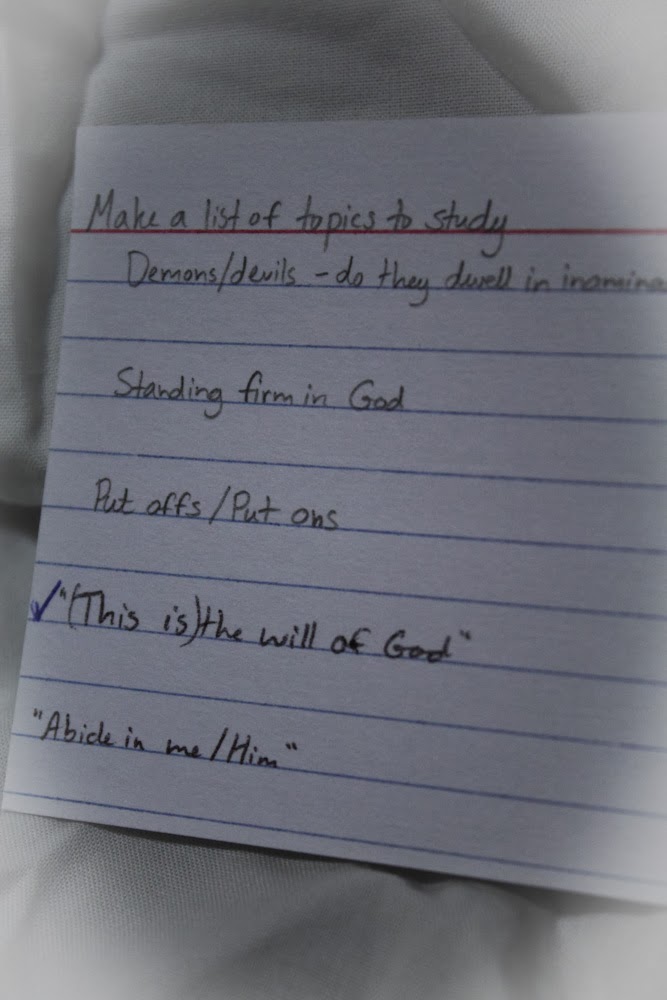
Keep a List
As you read through those questions, the Lord may have prompted your heart about a few topics. Write them down. Now. Keep your list handy (in the front sleeve of your Bible, on your night-stand, anywhere you frequent) so that any time a topic or question comes to your mind, you can jot it down to remember for later. This list is very useful when you have completed one topic and are wondering what to study next.
Gather Your Supplies
There are several tools that are very helpful to have when you study God’s Word: Strong’s Exhaustive Concordance, Webster’s 1828 dictionary (assuming you are studying with the King James), and a notebook. If you are using your computer, I highly recommend e-Sword (www.e-sword.net), a free Bible software program on which you can download all of these resources.
Prepare Your Heart
There are different ways to approach the Bible, both good and bad:
     ~to extract from Scripture what it actually says (exegesis)
     ~to read into it what you want it to say (eisegesis)
     ~to learn what God’s Word really says about an issue
     ~to fuel your argument and prove your point to someone else
     ~to go to God’s Word with your mind already made up what you want to see
Psalm 119:18 says, “Open Thou mine eyes, that I may behold wondrous things out of Thy law.” Our motive for studying God’s Word should never be to prove our points but to open our hearts to what God wants to teach us. Before we study, we should always set aside time to prayerfully prepare our hearts and ask God to give us a teachable spirit so that He can do His work in us.


Waiting for What "Foundation?" | From the Archives

There are many “buts” in our life. The “buts” are generally . . . excuses. “I would do this, but . . .”
The other day, I found a very interesting “but” in God’s Word. 

From the first day of the seventh month began they (Israel) to offer burnt offerings unto the LORD. But the foundation of the temple of the LORD was not yet laid. (Ezra 3:6)

Israel was coming from the pagan enemy’s land to rebuild the temple by decree of King Cyrus (see Ezra 1:1-3). Almost immediately when they returned to Jerusalem, the city of the temple, they began sacrificing to God. 
Nothing hindered their service to the one true God. Not even the fact that the temple was not prepared or ready!
As I read this captivating story of Israel’s return to God, I began to realize that there are many “foundations” I am placing as prerequisites for my service to God. Things that in my eyes make sense, but in reality are a just an excuse for my disobedience to God’s gentle prodding. 
It can be as easy as, “Lord, if you answer this prayer, then I will . . .” or, “Yes, Lord, I see that I should do this, but I must wait until tomorrow.” or as far-sighted as, “Lord, I’ll do this, but it makes sense to be married first.” 
When we feel God’s leading, we do not need the “foundation of the temple” to be set in order before we begin. We can begin as soon as He tells us.
What “foundation” are you waiting for before giving your life, your possessions, and your time to God?